
Falcon 900
Seats
13
Maximum Range (nm)
3640
ICAO Code
F900
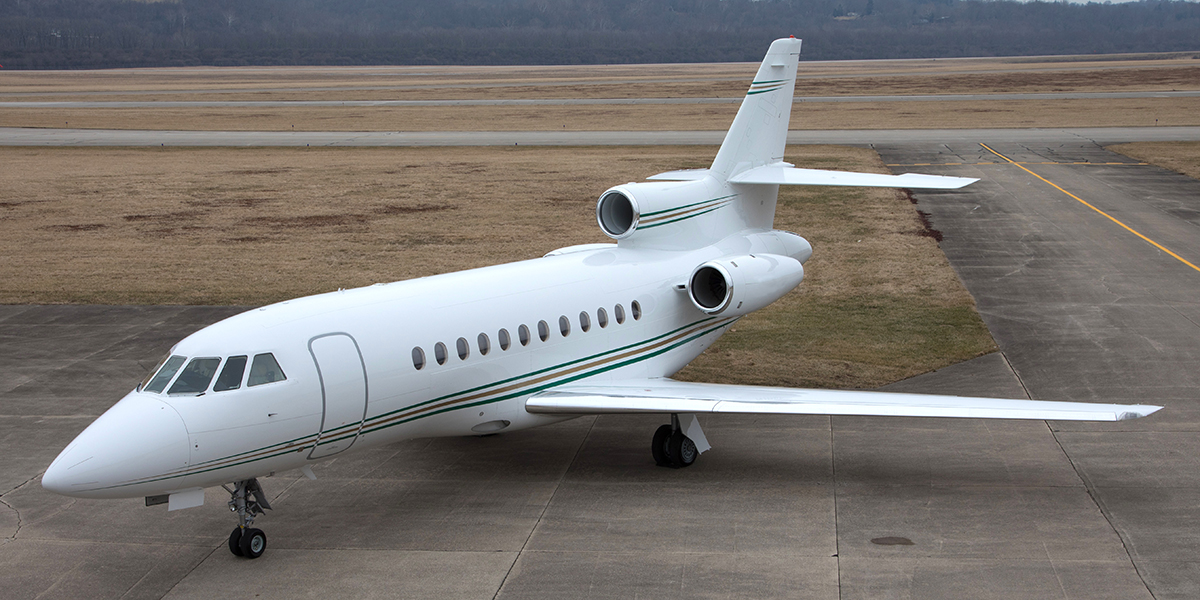


Falcon 900
Introduction
The Dassault Falcon 900 is a long-range business jet developed by French aerospace company Dassault Aviation. First introduced in the mid-1980s, the Falcon 900 was a game-changer in the private aviation industry, thanks to its tri-jet design, spacious cabin, and impressive intercontinental range. It combines performance, reliability, and comfort, making it a favorite among corporations, high-net-worth individuals, and government entities worldwide. As the first of its kind in the Falcon 900 family, this aircraft laid the foundation for several upgrades and variants, including the 900B, 900EX, and 900LX.
Specification of Falcon 900
Manufacturer: Dassault Aviation
Model: Falcon 900
Introduced: 1986
Crew: 2 pilots
Passenger Capacity: Up to 14 passengers (typical configuration 8-12)
Length: 66 ft 4 in (20.22 m)
Wingspan: 63 ft 5 in (19.33 m)
Height: 24 ft 9 in (7.55 m)
Cabin Length: 33 ft 2 in (10.11 m)
Cabin Width: 7 ft 7 in (2.34 m)
Cabin Height: 6 ft 2 in (1.88 m)
Baggage Capacity: 127 cubic ft (external and internal combined)
Maximum Takeoff Weight (MTOW): 45,500 lbs (20,638 kg)
Performance and Range of Falcon 900
One of the standout features of the Falcon 900 is its triple-engine configuration, consisting of three Honeywell TFE731-5AR-1C turbofan engines. This design improves short-field capabilities, enhances safety on transoceanic flights, and allows for flexible routing, especially in regions with ETOPS (Extended-range Twin-engine Operational Performance Standards) limitations.
Maximum Cruise Speed: Mach 0.84 (about 575 mph or 925 km/h)
Long-Range Cruise Speed: 430 knots (about 495 mph)
Range: Approximately 4,100 nautical miles (7,593 km)
Service Ceiling: 51,000 ft (15,545 m)
Takeoff Distance: 5,200 ft (1,585 m)
Landing Distance: 2,400 ft (732 m)
This performance profile enables the Falcon 900 to fly nonstop from New York to Paris, London to Dubai, or Tokyo to Honolulu under optimal conditions, delivering true global reach for private travelers.
Cabin Comfort and Interior of Falcon 900
The Falcon 900 offers a large and highly customizable cabin that ensures maximum comfort on long-haul flights. Dassault's attention to detail is evident in its high-quality materials, noise insulation, and ergonomic design.
Seating Configuration: Typically includes club seating, a conference/dining area, and a divan.
Cabin Zones: Often divided into three sections—ideal for work, relaxation, and sleep.
Cabin Noise Level: Extremely quiet for its class, enhancing the in-flight experience.
Amenities: Fully enclosed lavatory, full-service galley, entertainment systems, satellite phone, Wi-Fi (on many upgraded models), and optional sleeping arrangements.
Passengers enjoy panoramic windows, elegant finishes, and cabin pressurization that reduces fatigue—ideal for business travelers who need to arrive refreshed and ready.
Avionics and Technology of Falcon 900
At its launch, the Falcon 900 featured cutting-edge avionics for the time, but many models have since been upgraded with modern technology suites to ensure safety, efficiency, and compliance with current airspace regulations.
Original Avionics Suite: Collins Pro Line 4
Typical Upgrades: FMS with GPS capability, Enhanced Ground Proximity Warning System (EGPWS), Traffic Collision Avoidance System (TCAS II), and modern autopilot functions.
Optional Upgrades: Synthetic Vision System (SVS), ADS-B Out, Wi-Fi connectivity, and heads-up display (HUD).
The tri-jet setup also allows better engine-out performance, adding an extra layer of safety and route flexibility, especially when flying over remote or mountainous terrain.
Operational Advantages of Falcon 900
The Falcon 900’s operational flexibility is one of its strongest selling points. Its trijet configuration not only improves safety but also allows it to operate on shorter runways than many twin-engine aircraft in its class.
Runway Versatility: Can operate from high-altitude and short-field airports like Aspen, St. Moritz, or Teterboro with ease.
Reliability: Renowned for durability and minimal downtime.
Fuel Efficiency: Despite its three engines, the Falcon 900 is fuel-efficient due to its aerodynamic design and lightweight structure.
Resale Value: Maintains strong value in the pre-owned jet market thanks to its proven track record and Dassault’s support infrastructure.
These features make the Falcon 900 a favorite among fleet operators, multinational corporations, and individuals who require maximum mission flexibility.
Who Should Charter Falcon 900
The Falcon 900 is ideal for:
Business Executives & Corporations: Its range and cabin comfort allow nonstop transcontinental and intercontinental business trips with in-flight productivity.
High-Net-Worth Individuals & Families: Its large cabin and storage make it suitable for luxury vacations or relocating between homes.
Government or Diplomatic Use: Often used by state departments for secure, long-range travel.
Film & Entertainment Industry: Quiet cabin and long range support the logistics of high-profile events or global production schedules.
Medical Evacuation or Special Missions: Spacious interior allows reconfiguration for medevac missions or sensitive cargo transport.
Its combination of performance, comfort, and safety makes it a go-to aircraft for those who demand reliability and luxury in one package.
Charter Cost Estimates for Falcon 900
Chartering a Falcon 900 depends on factors like flight duration, location, repositioning fees, and peak travel times. Below are approximate costs:
Hourly Charter Rate: $6,500 – $8,500 USD
One-Way (NYC to LA): $45,000 – $55,000
Round-Trip (London to Dubai): $85,000 – $100,000
Minimum Daily Usage: Usually 2 hours per day minimum
Additional Costs: Landing fees, overnight charges, crew per diem, and de-icing fees (if applicable)
While not the most cost-effective in hourly terms, the Falcon 900 offers value through long-range performance and the ability to serve multiple passengers in comfort over long distances.
Conclusion
The Dassault Falcon 900 is a standout in the world of long-range private jets. With its triple-engine configuration, luxurious cabin, and global range, it represents a perfect fusion of safety, performance, and refinement. Whether for business, leisure, or government missions, it provides unparalleled flexibility and reliability. Over the years, its enduring design has given rise to several successful variants—each building on the solid foundation laid by the original Falcon 900.
For travelers who demand world-class capabilities wrapped in French elegance and engineering, the Falcon 900 remains a timeless and versatile choice in business aviation.